
The enterprise automation landscape is undergoing a fundamental paradigm shift. For years, Robotic Process Automation (RPA) and deterministic workflows have been the bedrock of operational efficiency, excelling at executing high-volume, structured tasks. However, as organizations scale, standard task-repetition is no longer a sufficient competitive advantage.
Enter AI Agents. Driven by advanced Large Language Models (LLMs), machine learning, and semantic memory, AI agents are transitioning enterprise operations from automated tasks to autonomous intelligence. Industry data indicates that roughly 40% of enterprise applications will feature task-specific AI agents this year, highlighting a massive migration toward autonomous decision-making
For enterprises evaluating their technology roadmap, understanding the structural and economic differences between traditional automation and AI agents is critical to driving true operational transformation.
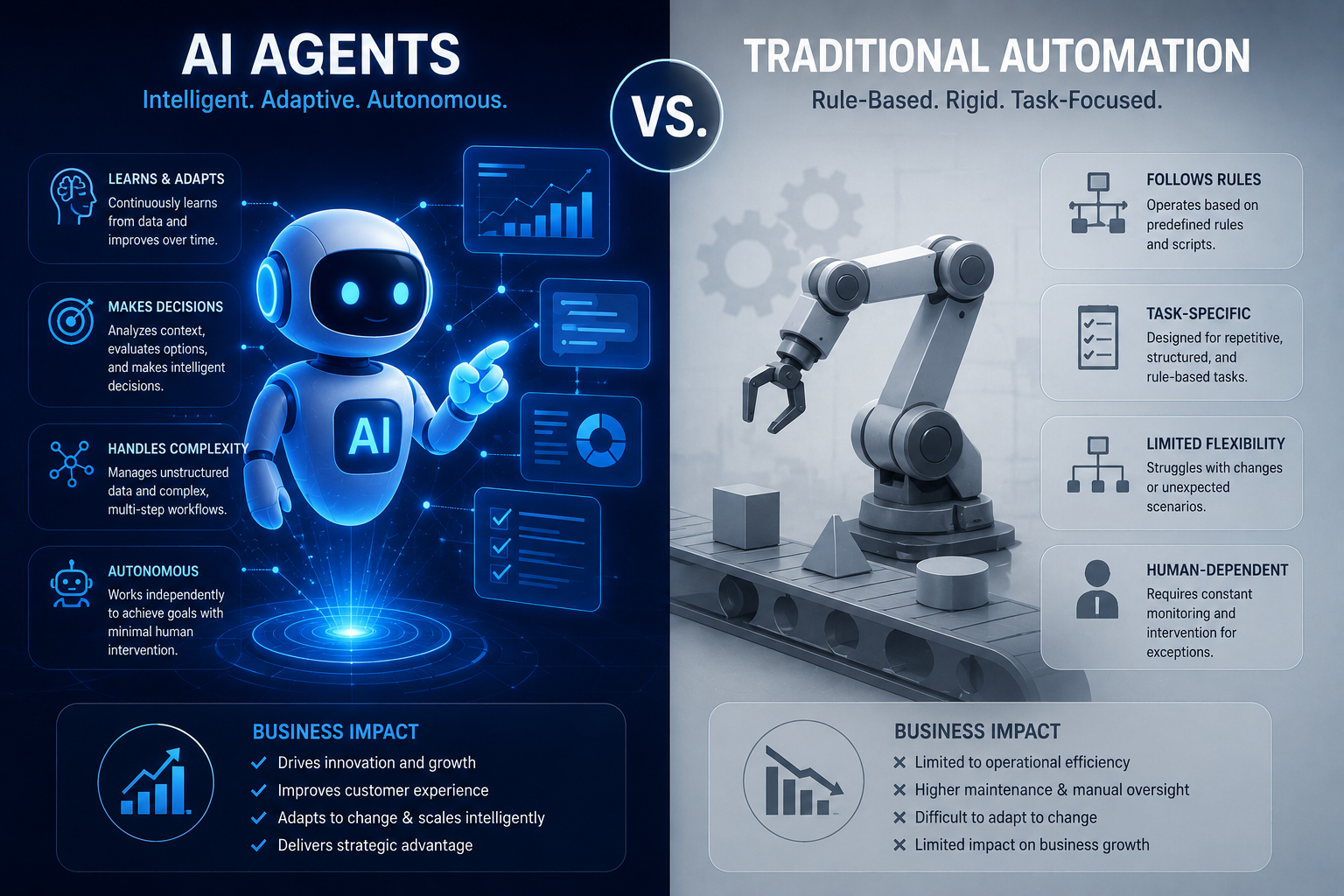
The Core Distinction: Rules vs. Reasoning
To properly position these technologies within an enterprise stack, it helps to distinguish their operational logic. Traditional automation does exactly what it is told; AI agents decide how to achieve a given goal.
[Traditional Automation] ──> Executes a Predefined Script ──> Requires Structured Data
[AI Agent (Agentic AI)] ──> Analyzes Dynamic Context ──> Resolves Unstructured Exceptions
Traditional Automation (RPA): Follows rigid, explicit if/then programming. It relies heavily on structured data inputs and predictable user interfaces. If a data field shifts slightly, an API endpoint mutates, or an unexpected edge case arises, the system breaks. It is deterministic, highly reliable for fixed tasks, but intrinsically brittle.
AI Agents: Are goal-driven and adaptive. When handed an objective, an AI agent coordinates its own workflows, selects the necessary digital tools, reads unstructured data (such as emails, legal contracts, or market telemetry), and handles exceptions autonomously. It operates effectively in the ‘gray areas’ where human judgment was previously required.



Where Each Architecture Wins: Enterprise Use Cases
Deploying AI agents everywhere is an expensive architectural error. Instead, high-performing enterprises implement a hybrid model, orchestrating traditional systems alongside autonomous layers to maximize efficiency.
Customer Operations & Support
Traditional Automation Wins: Tier-0 issues like password resets, order tracking status, and standard FAQ retrieval. These require structured database checks and cost fractions of a cent per execution.
AI Agents Win: Tier-1 and Tier-2 evaluations requiring deep context synthesis. An AI agent can ingest an ambiguous customer complaint, analyze the account’s historical ledger across multiple CRM platforms, cross-reference current corporate policies, and draft an optimized, compliant resolution
Operations & Web3 Architecture
Traditional Automation Wins: Processing structured digital ledgers, executing scheduled transactional batch files, and verifying standard cryptographic proofs
AI Agents Win: Managing multi-variable tokenized ecosystems, dynamic risk assessment, and executing smart contract exceptions. In complex Web3 environments, such as deploying scalable Tokenomics Designframeworks, AI agents act as intelligent node orchestrators, dynamically assessing real-world asset (RWA) data fields, validating cross-border compliance, and mitigating protocol vulnerabilities in real time.
Lead Generation & Market Intelligence
Traditional Automation Wins: Scraping form fields, routing inbound leads via predefined geographic rules, and launching static drip email sequences.
AI Agents Win: Inbound qualification and intent-based pipeline generation. An agent can research a prospective enterprise target across open-source intelligence feeds, analyze corporate filings, match current pain points against a product matrix, and execute hyper-personalized B2B outreach workflows.
Architectural Framework: When to Build an AI Agent
Before allocating capital toward an AI agent development pipeline, enterprise product teams should stress-test their target use case against a clear four-step framework:
Evaluate Data Ingestion State: Examine the core inputs of the process. If the input data is entirely structured and uniform, default to traditional, low-overhead rules engines. If inputs are highly unstructured or contain natural language, proceed to agent evaluation.
Quantify the Process Exception Rate: Measure how often a workflow breaks due to edge cases. If exceptions occur in less than 15% of cases, traditional automation with standard human-in-the-loop validation is usually most cost-effective. If exception rates exceed 20%, an adaptive AI agent is justified.
Map the System Blast Radius: Analyze the financial, legal, or security impact of an incorrect autonomous decision. High-risk systems (e.g., automated treasury movements) require rigid execution layers or deterministic guardrails, limiting the agent to an advisory or drafting role.
Design the Interoperability & Observability Layer: Confirm the underlying tech stack supports trace logging and vector memory spaces. An AI agent cannot operate effectively without clean semantic search pipelines (like Retrieval-Augmented Generation) and transparent audit paths for every tool call it makes
Balancing the Balance Sheet: The ROI Reality
A common pitfall is ignoring the unit economics of agentic systems. Traditional automation carries an upfront development cost but executes at an incredibly low transactional cost (often less than a cent per run).
AI agents leverage large-scale token processing, meaning their ongoing compute cost can be 50 to 500 times higher per individual transaction.
The ROI Rule of Thumb: Do not deploy an AI agent for millions of high-volume, static transactions where a simple script suffices. Deploy agents for high-value knowledge workflows, where replacing or augmenting complex human administrative time converts directly into significant overhead savings
Driving the Next Generation of Enterprise Intelligence
The debate is no longer about choosing AI agents over traditional automation, it is about orchestrating them together. Successful enterprises use deterministic scripts as the digital muscle to execute transactions, while utilizing AI agents as the analytical brain to handle nuance, strategy, and unstructured environments.
Navigating this transition requires specialized systems engineering, careful tokenomic structuring, and robust Web3/AI architecture. Whether seeking to tokenize real-world assets, design resilient Web3 economic frameworks, or build autonomous agent pipelines, the underlying infrastructure dictates long-term scalability.
Ready to build the future of enterprise architecture? Connect with BrightNodes today to collaborate with expert consulting teams and unlock advanced token-based systems, smart contract infrastructure, and decentralized product development.
