
AI Agents vs Traditional Automation is changing the way businesses automate processes and improve operational efficiency. Traditional automation follows predefined rules, while AI agents can learn, adapt and make intelligent decisions based on real-time data.
For years, Robotic Process Automation (RPA) and deterministic workflows have been the backbone of operational efficiency, excelling at high-volume, structured tasks. Now AI agents, driven by large language models, machine learning and semantic memory, are moving enterprise operations from automated tasks to autonomous intelligence.
For enterprises evaluating their technology roadmap, understanding the structural and economic differences between traditional automation and AI agents is critical to driving true operational transformation.
The Core Distinction: Rules vs. Reasoning
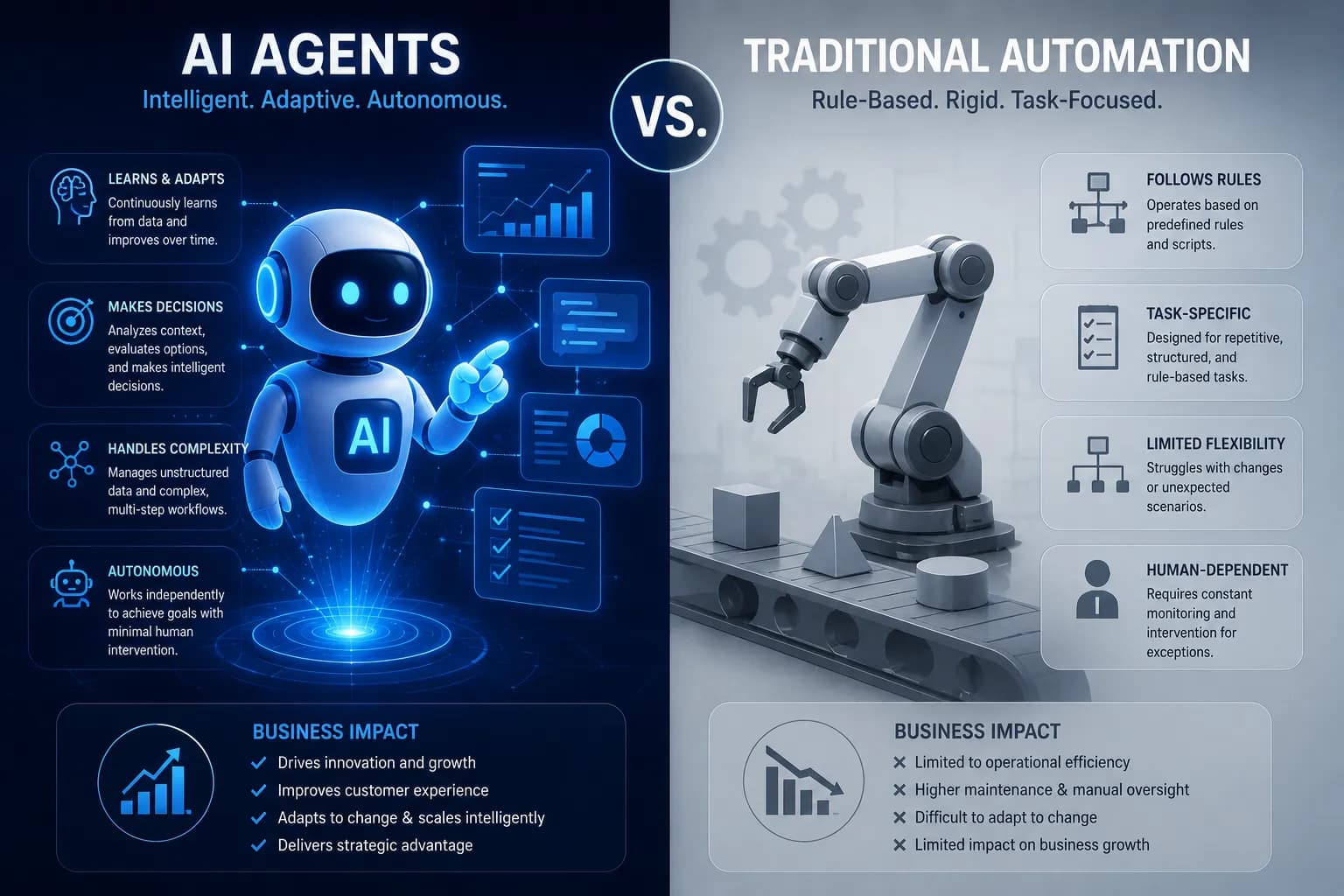
Traditional automation does exactly what it is told. AI agents decide how to achieve a given goal.
Traditional Automation (RPA): follows rigid, explicit if/then programming. It relies on structured data inputs and predictable user interfaces, so a changed data field or an unexpected edge case can break it. It is deterministic and highly reliable for fixed tasks, but intrinsically brittle.
AI Agents: are goal-driven and adaptive. Given an objective, an agent coordinates its own workflows, selects the tools it needs, reads unstructured data and handles exceptions autonomously. It works in the grey areas where human judgment was previously required.



Where Each Architecture Wins: Enterprise Use Cases
Deploying AI agents everywhere is an expensive architectural error. High-performing enterprises implement a hybrid model, using traditional systems alongside autonomous layers to maximize efficiency.
Customer Operations & Support
Traditional wins: tier-0 issues such as password resets, order tracking and standard FAQ retrieval, which need structured database checks at a fraction of a cent per request. AI agents win: tier-1 and tier-2 cases that need deep context, where an agent can analyze an ambiguous complaint and the customer’s history and draft a compliant resolution.
Operations & Web3 Architecture
Traditional wins: processing structured digital ledgers, running scheduled transactional batches and verifying standard cryptographic proofs. AI agents win: managing multi-variable tokenized ecosystems, dynamic risk assessment and smart contract exceptions, such as assessing real-world asset data fields and cross-border compliance.
Lead Generation & Market Intelligence
Traditional wins: scraping form fields, routing inbound leads by predefined rules and sending drip emails. AI agents win: intent-based qualification, researching a target across open sources and matching pain points to your product for personalized outreach.
Architectural Framework: When to Build an AI Agent
Before committing capital to an agent, stress-test your use case against a four-step framework:
- Evaluate Data Ingestion State: if the input is entirely structured and uniform, default to traditional automation; if it contains natural language, consider an agent
- Quantify the Process Exception Rate: when exceptions are rare, human-in-the-loop validation is usually most cost-effective; if exceptions run high, an AI agent is justified
- Map the System Blast Radius: assess the financial, legal or security impact of an incorrect autonomous decision
- Design the Interoperability & Observability Layer: confirm your stack supports trace logging and vector memory spaces so the agent can operate reliably
Balancing the Balance Sheet: The ROI Reality
A common pitfall is ignoring the unit economics of agentic systems. Traditional automation carries an upfront development cost but executes at an extremely low cost per transaction. AI agents rely on large-scale token processing, so their ongoing compute cost can be many times higher per transaction. Rule of thumb: deploy agents for high-value knowledge work, where replacing or augmenting complex human administrative time converts directly into significant overhead savings, not for high-volume simple scripts.
Driving the Next Generation of Enterprise Intelligence
The debate is no longer about choosing AI agents over traditional automation. It is about orchestrating them together: deterministic scripts as the digital muscle to execute transactions, and AI agents as the analytical brain to handle nuance, strategy and unstructured environments.
Ready to build the future of your enterprise architecture? Connect with BrightNodes to collaborate with expert consulting teams and unlock advanced token-based systems, smart contract infrastructure and decentralized product development.